
Hi! Last year I finished 135 books, the most I’ve read in a year since I started keeping track. Some were long, some were short; the average was 230 pages.

People often tell me I must read fast. I do not. I spend a lot of time reading. I ignore other things like housekeeping, social events, and new hobbies. I can read for short periods between other things, or for long stretches in the afternoon and before bed. I’m not entirely joking when I say my motto is “Bring a book and a spare.” I read almost entirely in print. I recognize the convenience of audio and e-readers, but I prefer books as objects, especially because I like to flip back and forth when a connection jogs my memory.
I started off the year with a quiet challenge: read at least a book a day. I’d gotten the idea years ago after I saw a review of the book Tolstoy and the Purple Chair (which I read this year), about a woman who started a daily reading practice after her sister died. That sounds like my kind of grieving, I thought. My dad had died of brain cancer in June 2022 after a long, painful decline. I was feeling the loss acutely after our first Christmas without him. In the dark winter of January 2023 I took shorter books off my to-be-read shelves and distracted myself by reading as many as I could. In February I started working in a bookstore again, and found I no longer needed the distraction of chain-reading books. (I switched to chain-buying books, which has caused a whole other issue, since we have, once again, run out of shelf space for all our books. But now we’ve run out of wall space to put new bookshelves, so I’m not sure what we’re going to do. I digress.)
By the end of February I’d finished a whopping 55 books. Over the next ten months I finished 80 more. For thirteen years I kept track of my books on Goodreads, which is not only a badly designed site but also is owned by evil empire Amazon, which means there’s plenty of money to pay people to make it better, yet they don’t. So, bye. Instead, I’m logging my books on Storygraph, which is independently owned, free, and functionally better than GR.
Unlike awards shows, I’m going to start off with the best of the best right away. (I know some people have already stopped reading. That’s OK! Not everyone is as into books as I am.)
My favorite book of the year was Good Behaviour by Irish writer Molly Keane, about a woman in post-WWI Ireland who is part of the crumbling aristocracy and grew up in a family so starved of love that she becomes monstrous. Much of the novel’s meaning lies between the lines and in allusions, which is brilliantly done. Keane published the book near the end of her life; it was nominated for the Booker award and lost that year to Midnight’s Children. The narrator is unreliable and unlikable. This is not a comfortable book, but rather a poisonous and fascinating one that benefits from multiple readings. It’s funny and tragic. Do not read if you’re depressed, want an easy read, or need likable narrators. I read it twice this year, first with friends Amy and Bee, and later with the #NYRBWomen23 online group, and flat-out loved it both times.
My other favorite book was Basic Black with Pearls by Helen Weinzweig, a Canadian writer. I’d never heard of the author or the book. Weinzweig never had a story or book rejected, which I find fascinating and astonishing. And the book is so singular that I have nothing to compare it to! Sarah Weinman, who penned the introduction (which I didn’t read till the end; spoilers! If I have one quibble with the NYRB series it’s introductions. Not a fan. Blerg.) calls it “an interior feminist espionage novel.” And it is! Which is bonkers and amazing! Also, unreliable narrator. A writing trope I love, because it encourages the reader to participate, to read between the lines, go spelunking for clues in the active engagement of the reading process. It’s not a fast read, or even a fun one but it was deeply pleasurable. I look forward to reading it again.

I read both these with an online reading group of New York Review of Books (NYRB) titles by women authors. The group read 2 books a month. I found out about it late and couldn’t manage to read all the books, but I did read 17 of them. Other favorites included The Mirador: Dreamed Memories of Irene Nemirovsky by her Daughter, Elisabeth Gille; A Chill in the Air and War in Val d’Orcia by Iris Origo, about life in the Italian countryside during WWII; Iza’s Ballad by Magda Szabo, a mother/daughter tale that is exquisitely wrought and deeply sad and yet so beautiful that it remains with me still; and Dorothy B. Hughes’ In a Lonely Place, a mesmerizing noir thriller by a woman that got turned into a very different Bogart movie that was great until I fell asleep and George had to tell me how it ended. Book: enthusiastic thumbs up! Movie: honk shoo. I loved the #NYRBWomen23 reading project and found so many books and authors that I wouldn’t have read otherwise.

Other books I loved: A Ghost in the Throat by Doireann Ní Ghríofa: memoir and history. A sleep deprived Irish mother of four becomes obsessed with an 18c Irish woman poet and tries to find evidence of her life. Evidence of V by Sheila O’Connor: memoir and fiction and poetry. Generational trauma and family secrets from 1920s Minnesota. To the Lighthouse by Virginia Woolf. Mrs. Ramsay, such a great character. And the house gets a point of view! Possession by A.S. Byatt. History, mystery, literary criticism, academic satire, romance, and poetry. A literary feast. Pride and Prejudice, which I read along with the delightful and erudite podcast Live from Pemberley. All were re-reads. A Ghost in the Throat is nonfiction, but I accidentally put it in the novel photo because it’s such a chimera.

Graphic novels/nonfiction. It’s Lonely at the Centre of the Earth by Zoe Thorogood and Ducks by Kate Beaton. Both were recommended by my friend Eric, who gives me the heads up on which comics and graphic novels I might like now that I’m not a weekly comic buyer. Both were artist coming-of-age tales. Thorogood’s was weird and horror inflected. Beaton’s was realistic and set in the oil fields of Nova Scotia. Great art, great stories.

Poetry: I finished the Collected Poems of H.D., a between-the-world-wars lesbian poet who was born in Bethlehem, PA but lived in England and wrote all her life. She lived in the same flat where Dorothy L. Sayers would write the first Peter Wimsey mysteries! H.D. was prolific, brilliant, and wrote widely. Satan Says by Sharon Olds. These poems in her first collection were so furious they nearly burned off the pages. Scorching and exciting. Autobiography of Red by Anne Carson: a queer love story told in verse but based out of ancient myth. So moving, tragic and lovely, while also erudite, ancient, and modern.
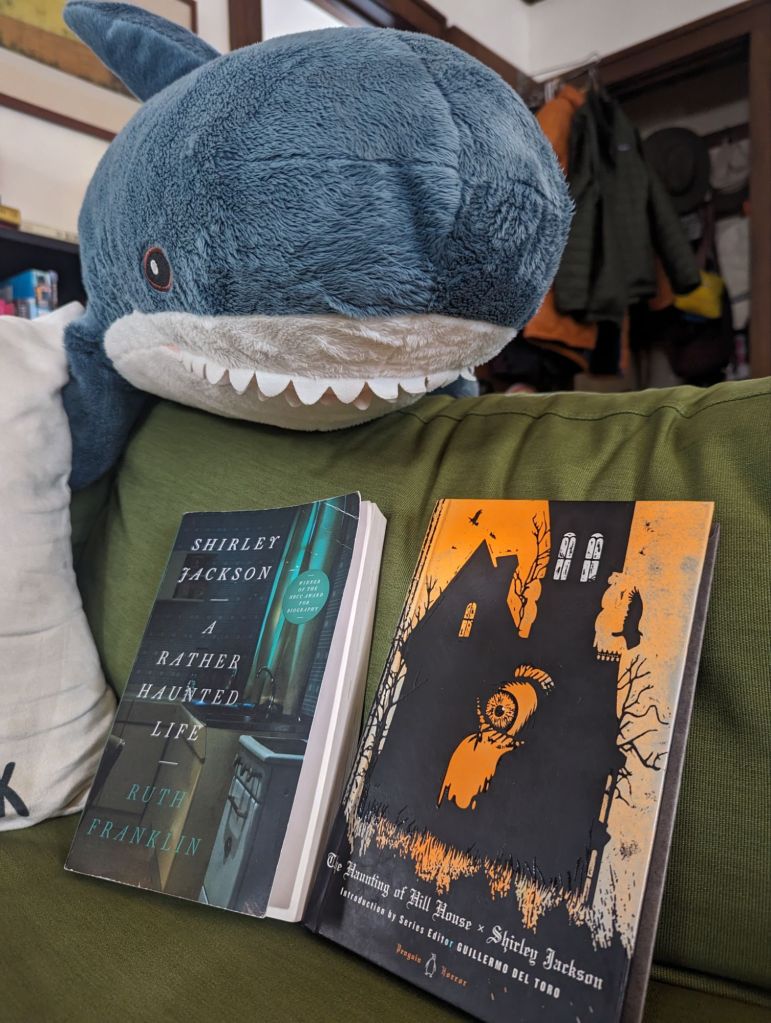
Deep dive: I read Shirley Jackson’s The Haunting of Hill House early in the year with one of my book groups. I watched the 1963 movie adaptation The Haunting. I read it again with one of my online groups led by Ruth Franklin, Jackson’s biographer, then read Franklin’s Shirley Jackson: A Rather Haunted Life, a thoroughly researched study with meticulous readings of the possibility of autobiography in Jackson’s own work. I bought a bunch of other Jackson books, but only managed to read her children’s book, 9 Magic Wishes, which is charming and lovely, a surprising departure for the normally dark, enigmatic Jackson.

Nonfiction: my two faves, along with the Ní Ghríofa, were Body Work by Melissa Febos, and Sister Outsider by Audre Lorde, which my senior in high school was reading for English. He didn’t love it. I was shocked and depressed but also heartened to see how much I did on this re-read, how timely is still is, and how prescient Lorde was about things like intersectionality. Body Work is Febos’ insight into the work of writing and memoir and how they can be transformative and revolutionary. These two books went well together.
Short stories: It’s a common practice in the writing world that if you know someone, you give their book five stars. Not out of ethical slipperiness, but just because it’s an act of kindness and generosity. I see it as recognition that a person I know has done a hard hard series of things: written a book, finished a book, gotten it published and put it out into the world. Hercules never did THAT.
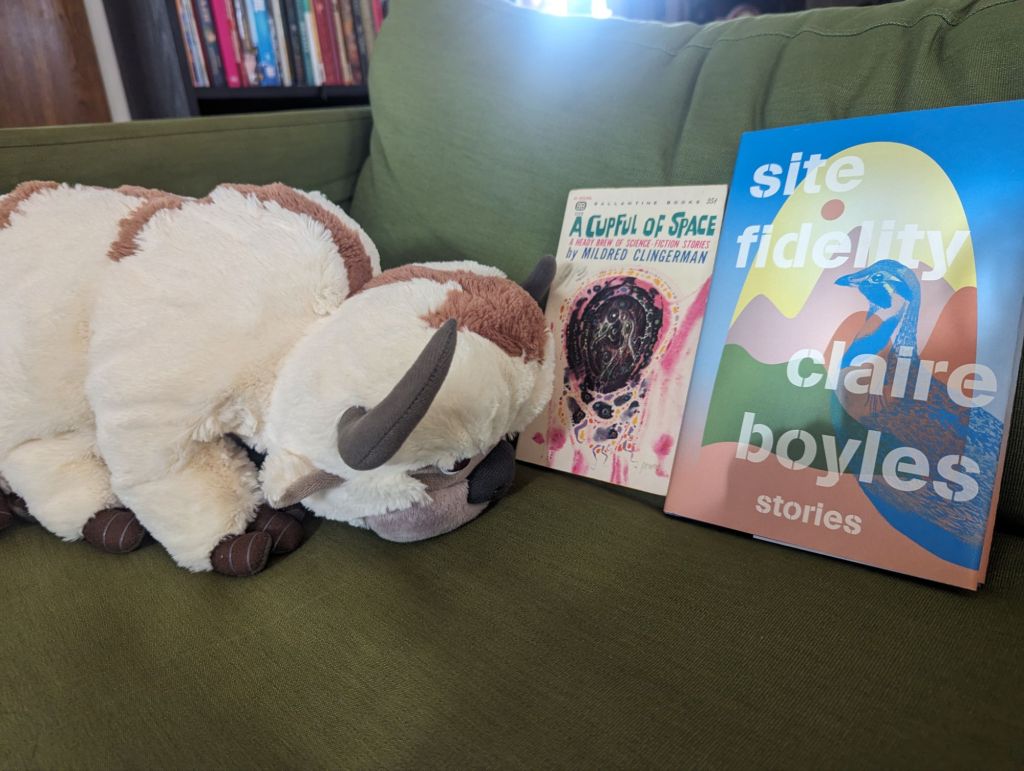
Anyway, I am acquainted with Claire Boyles, the author of Site Fidelity. But this was one of the best books I read last year whether I know her or not. These are stories of mostly women, mothers, daughters, sisters, and the difficult tasks of being in the world and wrestling with the decline of the natural world and climate change. I loved this book and recommended it many times. Do you like nature fiction? Connected short stories? Well-crafted prose? Read this book.
Not pictured is The Secret Life of Church Ladies by Deesha Philyaw. I must have lent this out. A great range of women’s stories that are beautiful and complicated and real with throbbing hearts.
The other collection was my obscure find of the year. The first book I finished in 2023 was American Christmas Stories edited by Connie Willis. Willis is a huge Christmas fan and has a collection of her own stories with an entertaining afterword that has recommendations for other Christmas media to enjoy, so she was the perfect editor for this anthology. Like almost any anthology, there were ones I liked, and ones I’ve forgotten or that annoyed me. But one story in it, “The Wild Wood” by Mildred Clingerman, stood out even though (or likely because) it was DARK and horrifying, with aspects of sexual trauma and feminist themes in a story written in 1957. It was followed by a Shirley Jackson story that was charming, cozy, and familial. Who was Mildred Clingerman, and how did she get a spook AF story in this Christmas anthology that felt way more Shirley Jackson than did Jackson’s own entry in the book? I poked around online and found she’d been a contemporary of Jackson’s and had published a collection of stories called A Cupful of Space. I found a used copy at Half Price Books, one with cool, skull-looking cover art by Robert M. Powers. I also bought The Clingerman Files, her posthumously collected short stories that includes the stories from A Cupful of Space plus many more. Like the work of Shirley Jackson, these stories are dark, unsettling, and often involve men impinging on women’s spaces and bodies. There are aliens, and time travel, and a little bit of a lot of things. This paperback was a big surprise, and that I found my way to it from a collection of Christmas stories was one of the weird delights of my reading year.
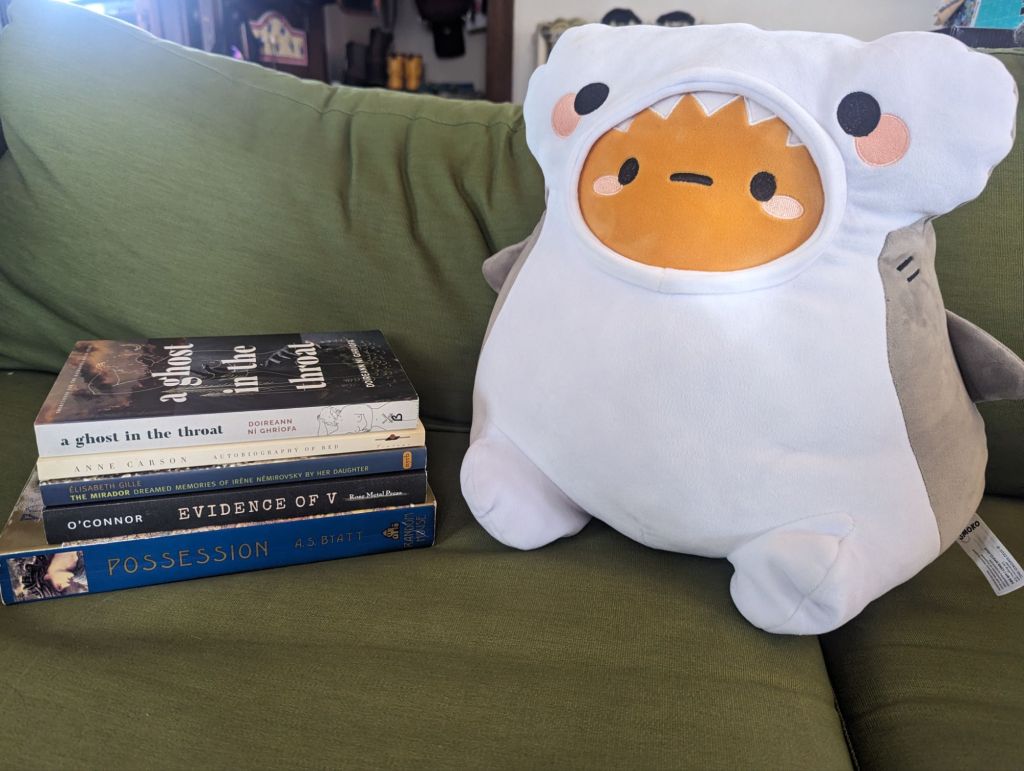
Another weird delight of my year was reading several books that were hybrids and were hard to categorize. Evidence of V, A Ghost in the Throat, and The Mirador were all books about a woman in the present finding a connection to one in the past, and excavating what facts she could find to construct a likely possible story, given the gaps in the historical narrative. Evidence of V says it’s a novel, though it’s filled with archival material. A Ghost in the Throat won awards, but received some savage reviews on Goodreads complaining about Ní Ghríofa’s focus on the domestic, depiction of breastfeeding, that the past story she conjured for Eibhlin Duvh wasn’t really real, and more. But where is the history supposed to come from if it’s been erased by patriarchal practices over centuries? All these books were doing radical, revolutionary work by creating something from absence. They all strongly reminded me of Byatt’s novel Possession, which was a hybrid itself, of stories past and present, poetry real and imagined, as well as literary criticism. I found these texts were rather monstrous, in the ancient meaning of the word, bringing maligned women monsters to my mind, like Medusa, Grendel’s mom, and the fairy Melusina, who featured in Byatt’s book. These authors sought justice in telling their stories as faithfully and truly as was possible, like Madeline Miller did in Circe and Maggie O’Farrell did in Hamnet, and Saidiya Hartman did in Wayward Lives Beautiful Experiments, all of which were favorite reads of the past few years for me. Anne Carson’s Autobiography of Red was another hybrid, of poetry, myth, and modern queer romance. While it had a male protagonist, I felt it sought to do the same kind of reclamatory work that the other books did. All these enthralled me this year.
Those were all my five star books. A few other books stood out in good ways: The Overstory by Richard Powers, The Dangers of Smoking in Bed by Mariana Enriquez, This is How You Lose the Time War by Amal El-Mohtar and Max Gladstone.
If you’re still with me, I’m going to crunch some numbers. I like to mull the statistics of the books I read, since it allows me to see whether I have a balanced reading diet, taking in a variety of authors and forms. In 2022 I only read 1 book in translation, and no books by trans or nonbinary writers; I noted I wanted to do better. I did! Last year I read 8 books in translation and 7 books by trans authors. Women authors, 101; men authors, 22; multiple authors, 8; nonbinary authors, 4.
As I tallied up genres, I realized my numbers didn’t add up, so I panicked. I considered creating a spread sheet from scratch, which is ridic, because I would have had to ask my tech support, i.e. spouse and local child, for SO MUCH help, and it would’ve taken hours. Then I wondered if this was all worthwhile and what was the point of anything, really. I took a break, had an eggnog latte and three gluten-free Oreos, and felt better, then sat down and counted again very carefully, using multicolored pens, and got to 135.
Unrelated: it has come to my attention recently that I might be neurodivergent in various ways. Draw your own conclusions.
Types of books: Novels 44; Nonfiction 35; Graphic novels/nonfiction 22; Poetry 20; Short stories 13; Drama: 1. I read about the same number of novels this year as last, but WAY more of the other types of books. For poetry and short stories, I read about twice as much as I’d done the year before, and this was also where I was able to bring in a lot more diversity of POVs.
There were a few disappointments. I don’t feel like dwelling on their faults. I only read a few books published in 2023, and none of them were on this list. If you’re interested, my reviews are at Storygraph. But even the disappointments usually had some moments, or some aspect that made me glad I’d spent time with the book. Still, a lot of books I owned at the beginning of the year are no longer on my shelves. They’ve gone to a better place. Which is not my house.
What were your favorite reads from last year?
 K.J. Boldon
If you own Basic Black with Pearls, I would love to borrow it. Reading your post makes me miss doing an end-of-the-year roundup. I read 128 books this year, which is my personal best. A potential addition to your Christmas reading for later this year is a British anthology called The Winter Spirits. I ordered it from the publisher directly and got a lovely hardcover, with some of the authors’ signatures, which is now sold out, but it’s coming out in paperback in the US this year. Very gothic and very fun. I also loved The End of Drum-Time, The Skull by Jon Klassen, Winter in the Air by Sylvia Townsend Warner, Kate DiCamillo’s The Puppets of Spelhorst, Iza’s Ballad, O Caledonia by Elspeth Barker, Good Behaviour, A Cupful of Space, and The Underneath by Kathi Appelt. It was a pretty good year in books!
LikeLiked by 1 person