
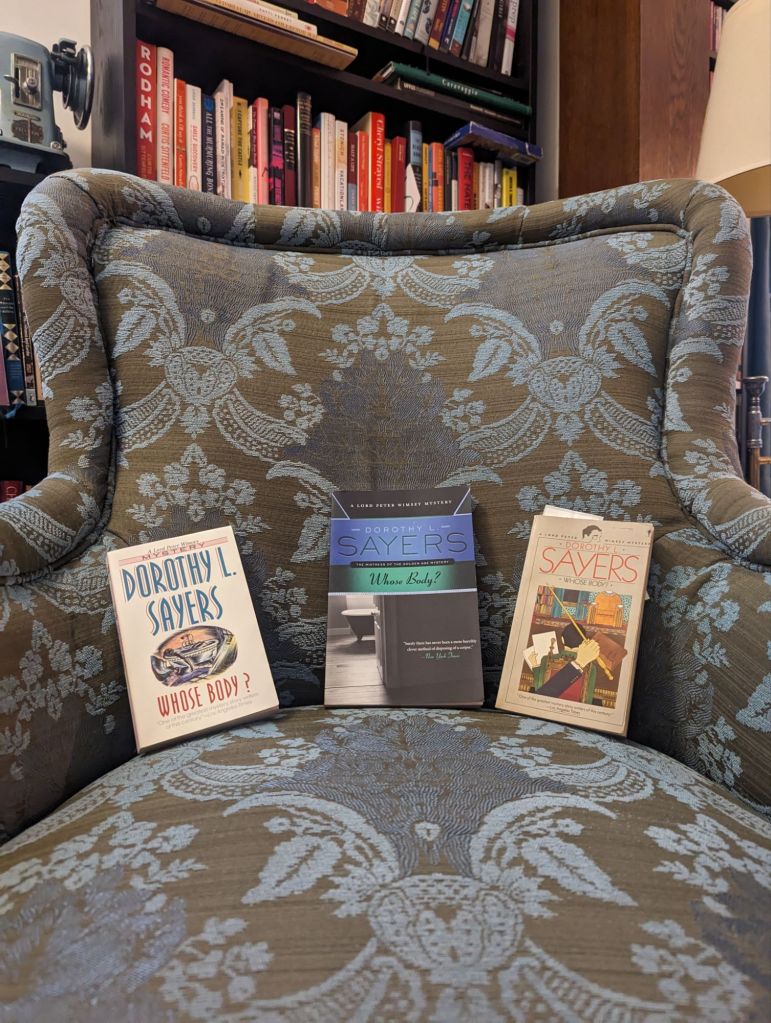
Starting in February 2024, I’m going to read one of Dorothy L. Sayers Peter Wimsey mysteries every month, which I’ll post here once a week.
I’m starting with the first book in the series, Whose Body? I’ll just be doing the novels, not the short stories. There are too many editions of those to be manageable, and they aren’t as good as the novels. People can do them as sidequests, but the main project will be the ten novels, in order to examine the progression of the characters and Sayers’s work over the series.
I’ll post on Thursdays and finish on the last Thursday of the month.
Thu February 8, 2024: ch 1-4 (1-61 in my Bourbon Street Books trade paperback edition)
Thu February 15, 2024: ch 5-6 (62-110 in my edition)
Thu February 22, 2024 ch 7-9 (111-146)
Thu February 29, 2024 ch 10-11 (147-198)
For first time readers, I don’t recommend introductions or afterwards; they’re spoiler-y.
Overall caution: the first time I read Whose Body?, I struggled. It had good elements, but I didn’t love it. It reminded me of a television pilot: it was putting elements of story and character in place, and seeing how they would play out. Over the series, the good stuff grows and the less good stuff diminishes. So if you start Whose Body? and are unimpressed, keep going. It gets so much better, and the series in its entirety is really quite a wonder.
Specific cautions: this book was published in 1923. One: There is anti-semitism, classism, a really gruesome murder, and probably other things I’ve forgotten that were of that time and are offensive now. I want to puzzle out the timeless aspects from the regrettable ones. Looking at how classism is handled over the series is another benefit to this reading as a larger project.
Two: chapter five almost stopped me from reading the rest of the book. Lord Peter and Mr. Parker discuss the facts of the case and the possibilities as they see them, something a modern reader has become used to doing themself. This is a classic example of a young author “telling” rather than “showing” what is important to the story. If you find yourself tempted to stop reading, you are not alone. It is possible to skip or skim these pages, with no ill effect. Again, the book gets better, as does the series.
Many of the books are now in the public domain, so can be gotten for free from Project Gutenberg. They are also easy to track down in used bookstores, at the library, plus have nice new trade paperback editions if you want to purchase them new from an indie bookseller.
Let me know if you have any questions, and I hope you’ll join me next month and the rest of the year to read along!
 K.J. Boldon