
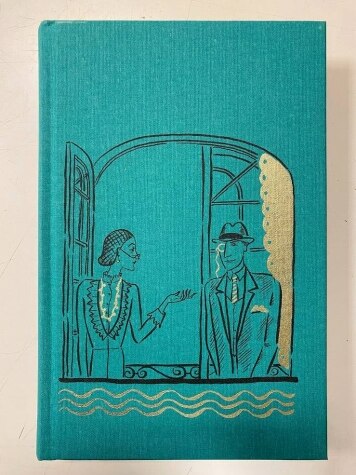
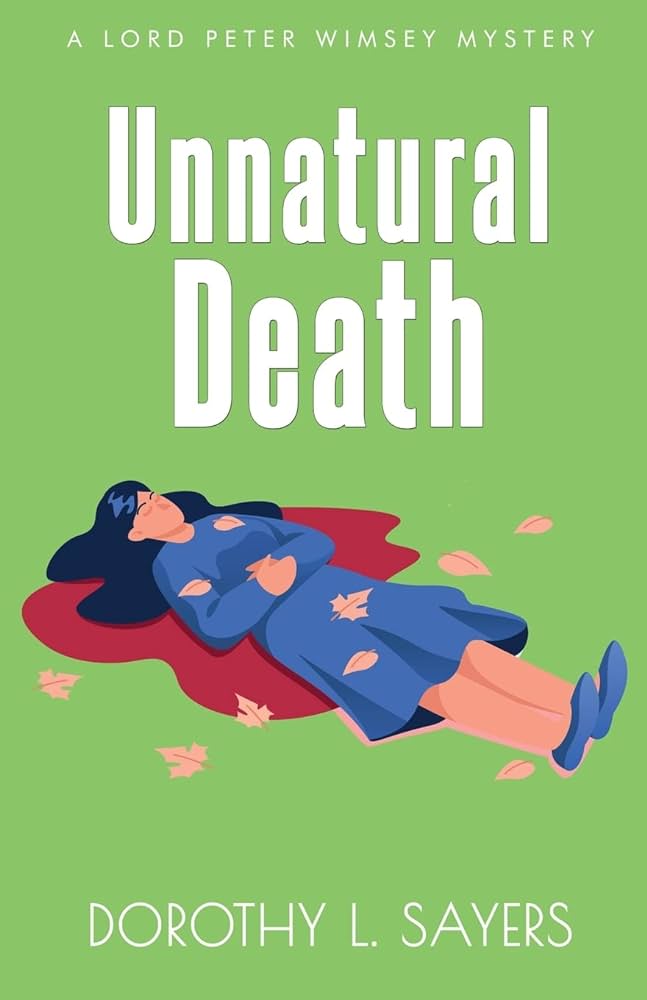
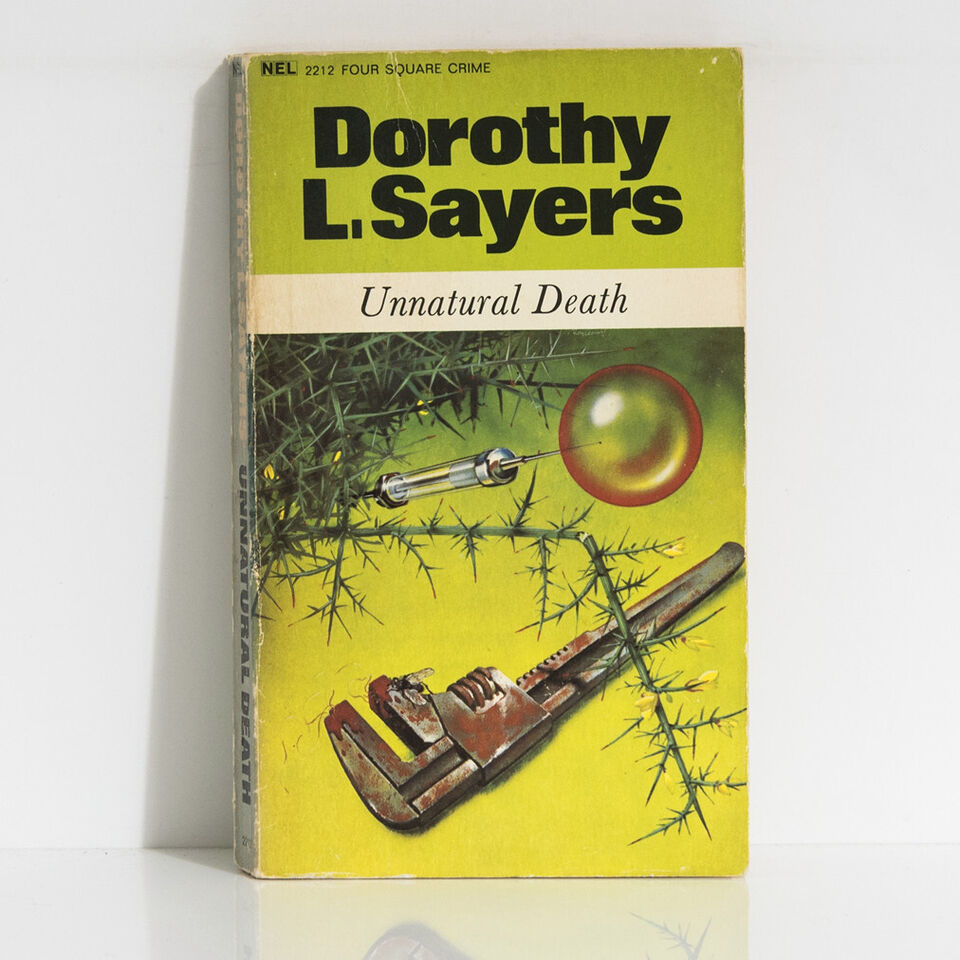
Here are a few of the many covers for Unnatural Death. I like them better than the ones on my mass-market paperback copies, both of which show a woman surrounded by blood in a bed, which isn’t in the book!
Again, on this third book in the Peter Wimsey series, I found the last act of the book disappointing after being riveted during the middle. Section I was the medical problem, section II the legal problem, and section III combines them into the “Medico-Legal Problem.” Parker, Wimsey, and Climpson are all running about, trying to be clever and figure out the mystery.
Part of my disappointment was the overt racism, which was most rampant in chapter 20. Part was the hiccupy time frame, which read as out of order to me, where Miss Climpson and Peter and Charles fall out of touch in section 2, and are only reunited at the very end. Also, there are the annoying coincidences, such as Miss Climpson finding Vera’s confession card, and then unknowingly picking out Mrs. Forrest’s apartment on her first guess.
Finally, I found there was something profoundly anti-feminist in the portrayal of Mary Whittaker as the killer, and the implication that she was at the least not heterosexual, if not what they called an “invert” at the time. How is she different from Julian Freke in the first book in her murderous impulse and attempts to get away with it? Yet I felt the portrayal of the murderous woman was given more disgust and gravity by Charles and Peter. There’s a way to have a villain who is part of a disenfranchised group (here, women) and make that a sign of acceptance and representation, but this was not one of those instances. Sayers, though, was still early in her writing career, and I hope that some of her views softened and changed, which I think they did.
My grievances were somewhat assuaged, though, because Miss Climpson lives to see another day (“Climpsons take a lot of killing!”) and Mrs. Forrest is arrested, while the policeman notes with satisfaction her rather incriminating response to the charges named: “Is that all?” The mystery of Agatha Dawson’s death is solved–it was an air bubble, which left no traces, which explains why Peter had to run across that kid on a motorbike so that his memory could later be jogged. (Lore has it that motorcycle aficionado Dorothy L Sayers had a similar problem at one time, which is where she got the idea, which was later shown to be not actually practice-able on a human scale.) Cousin Hallelujah, after being racist-ly framed, got to keep the money, and then Miss Whittaker hanged herself before her appointment to have somebody else do it for her.
Wimsey, as he did in Whose Body?, but didn’t in Clouds of Witness, is plunged into a funk by the serious consequences of his sleuthing. Both Bertha and Vera are dead because of it, as well as Whittaker herself. He is reminded of “the eight strokes of the clock which announce the running-up of the black and hideous flag,” a reference to the time hangings usually took place, and the flag that until 1902 announced them. (Eight Strokes of the Clock was also the title of one of the Lupin mysteries).
Wimsey is far from a strapping, triumphant hero, and the end of the book is a mood:
As the gate clanged open to let them out, they stepped into a wan and awful darkness. The June day had risen long ago, but only a pale and yellowish gleam lit the half-deserted streets. And it was bitterly cold and raining.
“What is the matter with the day?” said Wimsey. “Is the world coming to an end?”
“No,” said Parker, “it is the eclipse.”
How odd to come to the abrupt end of this book during the same week that a solar eclipse was taking place.
On finishing this third book, I do think it was better written, paced, and plotted than the first two. But this is still not a book I’d recommend to someone without many caveats. The addition of Miss Climpson to the Scooby Gang did liven things up. But the of-its-time racism, surprising-to-me sexism, and complicated ending all contributed to a book that would not be one I’d recommend to new readers of the series.
 K.J. Boldon