
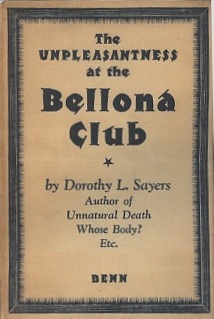
For the first three Peter Wimsey books (Whose Body?, Clouds of Witness, and Unnatural Death), I wrote weekly updates. This didn’t match well with how I read the books, which I prefer to do in one gulp. For book four, The Unpleasantness at the Bellona Club, I decided to skip the weekly posts, which led to the unsurprising result of zero posts–obviously suboptimal. Here I am, weeks after I finished the book, faced with the daunting prospect of writing up the whole novel. I think my past self’s plan of writing a little bit every week to keep me on track and work around my ADHD was a solid one. Because to write it up I’m going to split it into chunks to manage it and to make sure I can include images of the many covers.

The Bellona Club is one of several private clubs that Lord Peter Wimsey belongs to. On Armistice Day, he is there when they discover that General Fentiman is not dozing by the fire but dead. The time of death is important because the General’s rich sister had just died. If he died before her, then her money would go mostly to a distant young woman relative who lived with her. If he died after, then most of the money would go to him and from him to his grandsons, both veterans of the Great War and members of the Bellona Club. The elder, Robert, is hearty and well liked. The younger, George, is fragile in mind and body after being gassed in the war. Their lawyer asks Peter to investigate, who thinks, “The War pressed hard upon imaginative men in responsible positions.” (14, Bourbon Street Books.) Peter has episodes of PTSD and shell shock, which was shown in Whose Body? This thought sets up one of the threads of the book, the tension between the generations of older men who had been to war, and younger men who are damaged in body or psyche to a degree that the older generation doesn’t seem to empathize with or even want to acknowledge. Sayers, though, shows how damaged the new generation is: Tin Tummy Challoner takes the rattled George out of the room, (6) They move the body, but Culyer can’t help, as he only has one sound arm.

There is much harrumphing by characters like the lawyer, Murbles, the grouch Wetheridge, and Colonel Marchbanks, whose son died during the war and who meets each year with his son’s friends for dinner, that the old days and ways were better, and the new generation is a “soft” in a bad way. There’s an amusing exchange between Wetheridge and Wimsey, where the former complains about advertisers (39. Sayers worked in advertising until her books made enough money for her to quit her job), and the service in the club, until he accidentally admits to calling a friend who lost his son every year. “Wetheridge, having unexpectedly displayed this softer side of his character, relapsed into a snorting silence” and “grumbled his way through the end of lunch.” (40)

Peter takes one of Fentiman’s boots to his scientist buddy, the 1920’s version of Quincy or CSI, James Lubbock, a grouchy older man who complains about how easy it is to murder people. “it’s surprising how wasteful people are with their drugs. You can’t teach ‘em. An office-boy who was as incompetent as the average murderer would be sacked with a kick in the bottom.” (58)
Peter leaves the boot behind, because “a fellow looks such a fool carrying a boot about.” (58 Say that last bit aloud; it’s cleverly poetic.) He thinks to visit George and his wife Sheila, but recalls in time that dropping in would mean they’d need to offer him food, which they don’t have because they’re poor, so he goes to one of his other clubs and has “a Sole Colbert very well cooked, with a bottle Liebfraumilch (a semisweet white German wine), an Apple Charlotte and a light savory to follow, and black coffee and a rare old brandy to top up with—a simple and satisfactory meal which left him in the best of tempers.” (60-61) Money can’t cure PTSD, but it can make it more pleasant, as does Peter’s manservant Bunter “who looks after me like a mother.” (63)
By the end of this section, a reader will know that something is hinky with the body and time of death, but who did what, and when?
 K.J. Boldon