
If you found this site looking for more about the Peter Wimsey and Harriet Vane series by Dorothy L. Sayers, I hope you also will visit the site of the podcast As My Wimsey Takes Me, hosted by Charis and Sharon. I have been listening, learning, and enjoying their talking of piffle.
I wrote a fine post about Strong Poison by Dorothy L. Sayers on my phone and on a plane, and when I went to look for it, alas it was not saved. Strong Poison is the fifth mystery novel in the series, and the first to introduce the character of Harriet Vane, a mystery writer on trial for the murder by arsenic poisoning of her former lover Phillip Boyes. Peter Wimsey is attending the trial because she was arrested by his good friend Charles Parker, but soon becomes convinced that she’s innocent, and that he’s in love with her.
There were crimson roses on the bench; they looked like splashes of blood.
The judge was an old man; so old, he seemed to have outlived time and change and death. His parrot-face and parrot-voice were dry, like his old, heavily-veined hands. His scarlet robe clashed harshly with the crimson of the roses. He had sat for three days in the stuffy court, but he showed no signs of fatigue. (5, Avon 1967)
The first three chapters of the book are rather an info dump; the circumstances of the death are set out and the reasons that Harriet has been charged. I found this rather tedious, thought the text was leavened with interludes from old favorites from the supporting cast like friendly but not-too-bright Freddy Arbuthnot, the scattered Dowager Duchess, drunk reporter Salcombe Hardy (though I couldn’t find which paper he worked for in this book), and the ever resourceful Miss Climpson, quite recovered from being attacked in Unnatural Death. But in chapter four, Peter manages to set up a meeting with Harriet in prison, and it’s one of the most delightful meet-cutes I’ve ever read. Harriet says she knows who he is, having followed his career with interest.
“She smiled suddenly at him, and his heart turned to water.” (35)
He is awkward, but she manages to joke with him and quote pulp novels and otherwise entertain him until he says he’d like to marry her, and is utterly unprepared for her unenthusiastic response.
“Oh, are you another of them? That makes forty-seven…Proposals. They come in by every post. I supposed there are a lot of imbeciles who want to marry anyone who’s at all notorious.” (37)
He recovers from this faux pas and leaves, determined to prove her innocence and win her in the end. One of those things will happen by the end of the book.
The badinage between Peter and Harriet is a great deal of fun, and Harriet’s composure in contrast with Peter’s flustration (yes, it’s a word. Because I said so.) is immediately winning. In their back and forth, Peter asks if there’s anything about his appearance that Harriet would change.
“Don’t,” said Miss Vane, “please don’t alter yourself in any particular.” (39)
In a later conversation with Marjorie Phelps, who has been such a delightful part of the supporting cast in the previous books, what with their almost proposal in The Unpleasantness at the Bellona Club. He asks her to introduce him to the artist crowd that the dead ex, Phillip Boyes, ran with when he and Harriet were together. Marjorie takes him to a raucous party, and after, when he’s feeling his age: “I’m getting on forty, Marjorie.” (70) her response is striking. “Marjorie looked at him almost in alarm, and tucked her arm in his.
“Peter–please do be happy. I mean you’ve always been the comfortable sort of person that nothing can touch. Don’t alter, will you?”
That was the second time Wimsey had been asked not to alter himself; the first time the request had exalted him; this time it terrified him.” (71)
It’s another sign that Marjorie and he, while good friends, aren’t quite the meeting of equals that both of them deserve, which was why the conversation got dropped in the last book. She introduces them to the lesbian couple Sylvia and Eiluned, and when Peter is elated with news that might help Harriet,
“Marjorie looked at him and said nothing. She suddenly felt as though something inside her had been put through a wringer.” (75)
Oof, poor Marjorie. She’s losing her fun time buddy. But it’s also not fair of her to ask him to remain happy and comfortable, when in two places in this book alone, he contemplates suicide, a running theme in many books of this series.
“If I’ve got to find a homicidal maniac, I may as well cut my throat at once.” (42) and later, “When I blow my brains out–” He stopped. “I hope I shan’t need to want to. Mother wouldn’t like it, and it’s messy. But I’m beginning to dislike this job of getting people hanged. It’s damnable for their friends…I won’t think about hanging. It’s unnerving.” (92)
Other delights of this book for me were the expanding cast: Blindfold Bill the former safecracking thief, and Miss Murchison, a member of The Cattery, a group of spinster women employed by Wimsey in a sort of fraud prevention effort.
She notes that in Peter’s training, “Rule Seven, in particular, which ran: “Always distrust the man who looks you straight in the eyes. He wants to prevent you from seeing something. Look for it.” (167) It’s fun to imagine what the previous six rules would have been, and I wonder if Sayers had them stashed away in a notebook somewhere.
Another kind of Easter egg for me was when Peter tells Parker, “By the way, I should try the garden in Mecklenburgh Square. A thing might lie quite a long time under those bushes.” (47) Sayers lived for a time in a flat there, which I learned about when I read the excellent group biography Square Haunting by Francesca Wade.
And, as always there is never enough of the amazing Bunter, who can tell that Peter has fallen in love and asks if the circumstances might be changing. After their amusing conversation, “Bunter faded gently out…” (63) which reminds me of Homer Simpson backing into the shrubbery.
And I continue to appreciate Sayers’ ability to portray the differences and challenges among class and socioeconomic levels, and how Peter manages to deploy Bunter and a variety of women to get into places he can’t get himself. When Bunter interviews the staff at cousin Urquart’s house, the cook compliments someone: “‘Mrs. Pettican,’ she says to me, which I call it better manners than calling’ you Cook as they mostly do, as though they paid your wages for the right of callin’ you out of your name.” (76) It’s a short line, but telling, and also an example of how good Sayers is at dialogue, and how she both advances the story and uses it for characterization.
For a book about Harriet, she isn’t actually in it very much, and one complaint our discussion group had is why she, having researched arsenic, didn’t know the fact that the conclusion turned on. My gripe is that Peter didn’t work with her as an equal enough, but still the ending was a bookend to the beginning.
“There were golden chrysanthemums on the judge’s bench; they looked like burning banners.” (190)
And the exoneration was a relief: “Prisoner at the bar, the Crown, by unreservedly withdrawing this dreadful charge against you, has demonstrated your innocence in the clearest possible way. After this, nobody will be able to suppose that the slightest imputation rests upon you, and I most heartily congratulate you on this very satisfactory ending to your ordeal….Members of the jury, do you find the Prisoner Guilty or Not Guilty?”
“Not Guilty, my lord.”
“Very good. The prisoner is discharged without a stain upon her character. Next case.”
So ended, sensational to the last, one of the most sensation murder trials of the century.” (191)
This would have been a satisfying ending, if perhaps not an entirely accurate one, given future books, so it’s qualified by Harriet departing with Sylvia and Eiluned, while Peter has left, to respect her space, though his last interchange with his family at Duke’s Denver let’s him have the last word, “If she’ll have me.” (192)
Edited to add, I find another Brontë echo in this book. When Peter again asks Harriet in chapter 21 to marry him, she says, “I’ll live wiht you, if you like, but I won’t marry you.”
Her tone was so unutterably dreary that Wimsey could feel no enthusiasm for this handsome offer.
She thinks she’s being considerate, as his family would disown him, as hers did when she lived with Boyes. He assures her that the rich are different; he can do whatever he wants and they’ll close ranks. Harriet laughs.
“No, I suppose they can’t cut you. You wouldn’t have to slink abroad with your impossible wife and live at obscure continental watering places like people in Victorian novels.” (181)
I think this echoes the scene in Jane Eyre, after Jane has seen what’s in the attic. Rochester tries to bully her into acting married since they can’t do it legally or religiously, saying that he’s rich and they can go live on the Riviera and no one will care. Jane refuses. She’s holding out for a companionate marriage of equals. Here the gender roles are reversed, though the man is still the one with money and power. Harriet won’t settle for anything but a marriage of equals, and she knows that given the present circumstances, no matter how much Wimsey cajoles, it’s not possible.
The next book is the rather long and dull–Five Red Herrings, with no Harriet!
I’ll be back soon to write something about that, which, like all the books, does have its charms.
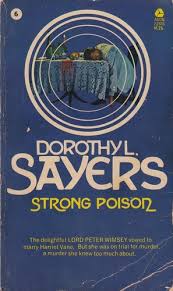
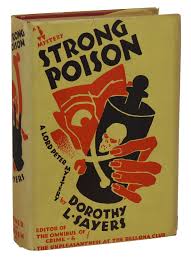
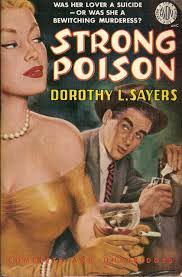
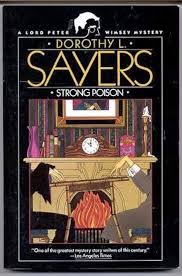
Edited also to add a bunch of the fun covers. The current US and UK ones I find dreadfully dull. Some here are lurid, and a few venture too far into giving away the game! I do like the seance one, with the tipsy table; an important scene, and yet not one that gives anything away.




 K.J. Boldon