
I used to keep track of my books on Goodreads, but it’s both owned and undersupported by Amazon, which I find confounding, so I jumped ship for Storygraph, where I post under KJBoldon.
The first book I finished in August was a mystery about a serial killer, The Vanishing Season by Joanna Schaffhausen. The writing was solid, the premise interesting and plot well executed; there was even a twist I hadn’t foreseen. Still, this type of mystery is not for me at this stage of life, which wasn’t a bad thing to be reminded of.
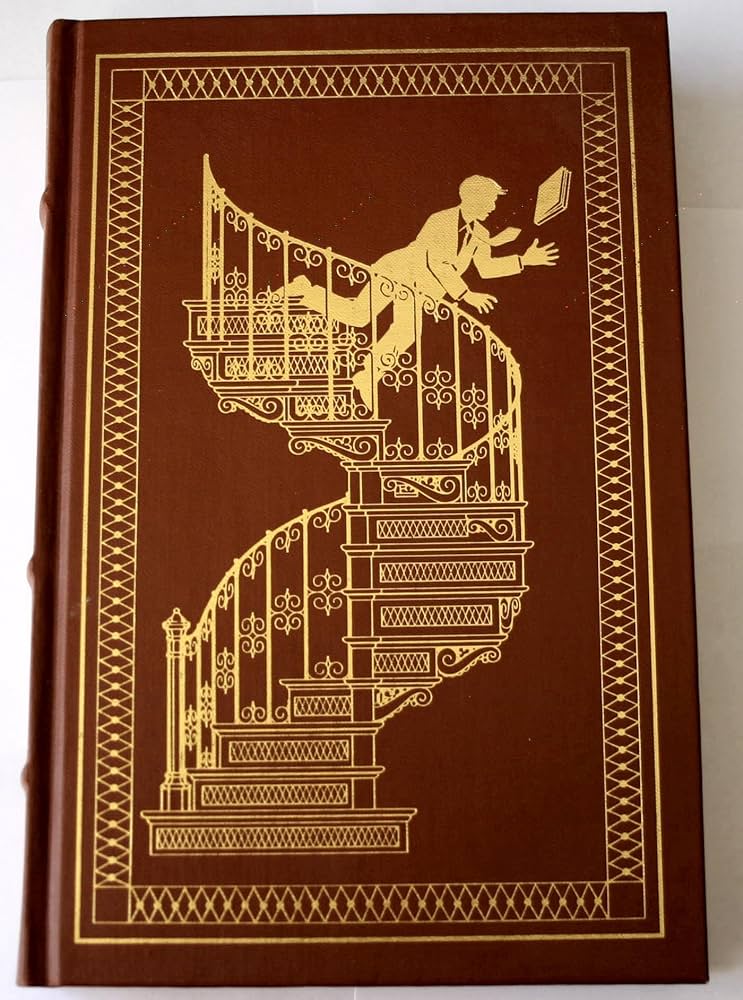
Murder Must Advertise, by Dorothy L. Sayers, on the other hand, was an utter delight to re-read, despite its many murders, and the rather lurid and somewhat silly plotline of a shadowy drug ring, which Sayers later admitted was perhaps beyond the reach of her grasp. Did you love the style of Mad Men, and the bizarre details of the advertising world and its office culture? This English mystery might be your thing, then. In 1930’s England, a copywriter no one much liked falls down a treacherous set of stairs and dies. Accident? Or murder? (Of course it’s a murder.)
Lord Peter Wimsey goes undercover as a copywriter to discover whodunnit. As usual, we get a stellar cast of supporting characters, which includes a socialist, a vapid but deadly party girl who just might have psychic powers, a hyper-competent woman in the office who knows what’s what but keeps her mouth shut, and a savvy office boy nicknamed Ginger Joe who is training to be a detective, encouraged by his friend at the office Death (it’s pronounced to rhyme with teeth) Bredon. There’s a long passage about cricket that one doesn’t need to know anything about cricket to enjoy. The scholar Jem Bloomfield has noted that he finds Sayers’ text “haunted” with echoes of Shakespeare’s Hamlet, and though at first I didn’t see it, now I can’t stop seeing it. “What’s the matter with you, Bredon?…You’re looking very white. Touch of the sun?”
“Too much light in my eyes,” (ch. 18)
In addition to the echoes of Hamlet, there is blackmail, assault, jealousy, and a costumed death-defying dive into a fountain. Some readers argue this novel would be a good one to introduce readers from this century to the Wimsey series. I’m not convinced. Wimsey spends the book undercover, and there’s not nearly enough of the delightful Bunter, the Jeeves to his Wooster. Currently, I think The Unpleasantness at the Bellona Club is my recommendation of where to start. I visited a lot of bookstores in August, and noticed that if they carry any Sayers, it tends to be Bellona; I think that’s a smart sales choice.
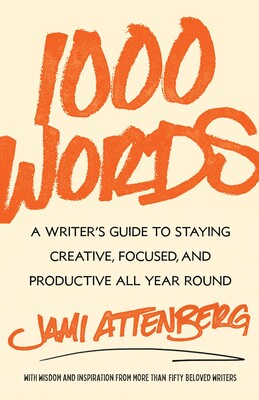
1000 Words: A Writer’s Guide to Staying Creative, Focused, and Productive All Year Round by Jami Attenberg (and friends) was also a delight. I spangled my copy with book darts at so many good pieces of writing advice. I read a few pages a day, and highly recommend this one for the writer’s personal permanent shelf. It would be worth owning even if only for the two-page spread on “How to Gently Restart,” and there’s so much more to dig into.
I was less thrilled with my morning few pages a day from The Brontës, Selected Poems. It was a slim, but slow volume. I would have appreciated some context for each of the poems, such as when and for what occasion it was written. I could tease out which were juvenilia and which written as adults, but that poor pack of four siblings had such limited life experience that I found the poem’s topics sadly limited. And repetitive. It made me long for the future of free verse.
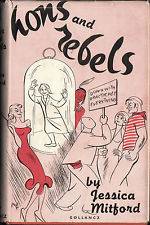
Another delight! Hons and Rebels by Jessica Mitford. This was my first Mitford, and it won’t be my last. I have long suspected that I’d find the Mitford clan fascinating, and with this book I surely did. I continue to find the back catalog of the New York Review of Books by women authors full of treasures, all the more so for the history embedded in their lines, fiction or not. I’m reading with a group on Twitter, #NYRBWomen24 and it’s been a wild ride.
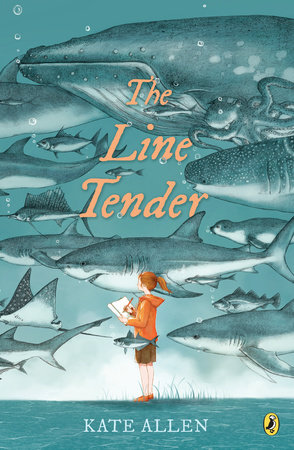
I work at a used bookstore, and one of the daily Sisyphean tasks is finding space on the shelves to put incoming books. I borrowed this book from work to make room on the shelf, but also because the beautiful watercolor art on the cover of a red-haired girl gazing at sharks utterly charmed me, as did the black and white pencil art of sharks within. The artist, Xingje Yin, is thanked in the acknowledgements but not listed on either the cover or the copyright page, which is unjust. A quick Google search doesn’t turn up the artist, either. This is a good book, made better by stunning art, outside and in. Give book artists and book designers credit, please! The book is a lovely throwback to the sad slow kind I remember from my childhood. There’s an absent mom, an absent-minded dad, a good friend you shouldn’t get too attached to, and lots of sharks. I ended up buying the book, and now have to confront the Sisyphean task of finding space on MY shelves.

This is How You Lose the Time War by Max Gladstone and Amal El-Mohtar. This was a re-read with one of my four (!) book groups, and I was glad for the opportunity. It’s a time-twisty romance with assassins and intrigue that I didn’t grasp a lot of what was going on, other than an epistolary romance, which is one of my favorite things. This time I could read more slowly (though it still propelled me right on through to the end.) so I could savor more of the details. If you start it and find it bewildering, keep going. It settles down. And if you finish it and are still perplexed, maybe give it another try. “If Blue were a scholar–and she has played one enough times to know she would have loved to be–she would catalogue, across all strands, a comprehensive study of the worlds in which Romeo and Juliet is a tragedy, and in which a comedy. It delights her, whenever visiting a new strand, to take in a performance not knowing how it will end. (158)
Gmorning, Gnight: Little Pep Talks for You and Me by Lin-Manuel Miranda and Jonny Sun. A co-worker adores this book, so I decided to give it a try, reading an affirmation each morning and night. It’s really funny, and sweet, sometimes, sad, and lovely, like the best books often are. Very cheering, and affirming even on the dark days.
That’s it for August, and I’m writing about it before the end of September, so I guess I’m winning? What have you been reading and appreciating?
 K.J. Boldon
Have I mentioned “Fire on the Mountain,” by Terry Bisson? It’s from the late 1980s, but a podcast pointed me to it this summer. It’s about a world where John Brown’s raid on Harper’s Ferry succeeds and the world created by it. Quite the palate cleanser to the dystopian alternative history now en vogue.
LikeLike
i don’t remember but it sounds fascinating, and I’m curious to see whether it has the bleak violence that so much post apoca fic has.
LikeLike
The violence in it is in Harper’s Ferry in the 1850s.
LikeLike
I feel like I have been reading WAY too much nonfiction for…years, really. I am trying to read more fiction, which I love, but I am not doing very well. There are just so many books I must read for work, which are all nonfiction and mostly about business. However, I am currently reading CUP OF GOLD by Steinbeck. I am working my way through his complete works. It’s weird and fun and very un-Steinbeck like.
LikeLike