
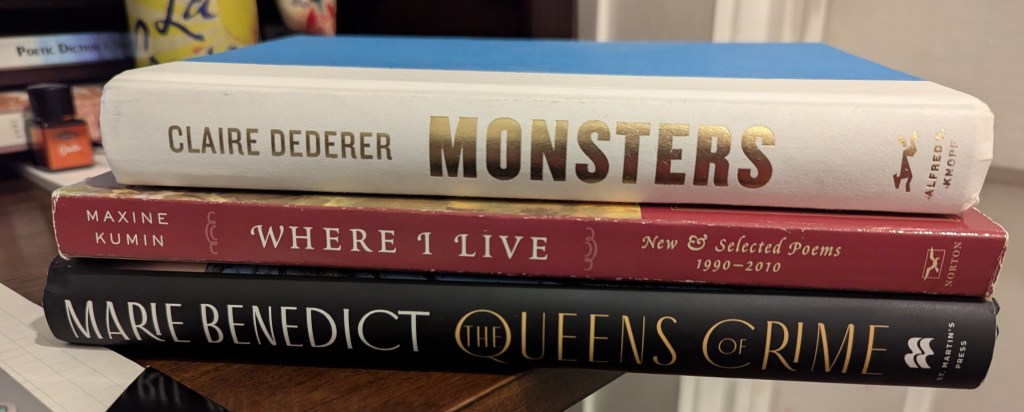
Monsters by Claire Dederer was recommended by a friend. In typical fashion, I nabbed it in hardcover but waited so long to read it that it was out in paperback. Between my Too Many Book Groups, I snuck it in. It grew from a piece Dederer did for The Paris Review, “What Do We Do with the Art of Monstrous Men” in which she wrestled with her love for the films of Woody Allen and Roman Polanski held alongside her abhorrence of the terrible things they’d done.
The book expands by including many more monsters, including some women, though I thought this was the weaker part of the book. For women monsters, she isolates women who abandon their children, and didn’t interrogate that nearly enough for me. She wrote about Sylvia Plath and Anne Sexton, who killed themselves and left children behind. She wondered, intriguingly, what might have been the alternate history if Plath had turned her killing rage on Ted Hughes instead. She spends a lot of time on Doris Lessing, but her coverage of Lessing is superficial. I read The Baby on the Fire Escape by Julie Phillips last year, which had a detailed chapter on Lessing. Lessing didn’t simply abandon two children and take a third to England to write. She got divorced from the father of her first two children, he prevented her from seeing them, trash talked her to them, she got married to someone else, had a third kid, then left for England with new family to pursue her work with the Communist Party and write. Is this monstrous, or just making the best of a terrible situation? But yeah, the Jenny Diski stuff is bad.
I think it’s easy to finish this book and say, well, we can still enjoy the art of [fill in the blank], not give the bad person money or defend their actions, and we’ll be OK because we’ve wrestled with it, we’ve worked out our own calculus of evil. Dederer’s book goes deeper into that murky water. E.g., a friend of mine says she’s appalled by Neil Gaiman, but will continue to read Alice Munro. I can’t help harking back to a book I read long ago, Mary Gaitskill’s Two Girls Fat and Thin, and its contention that abuse isn’t quantifiable. That book contends there is no calculator. Books by Gaiman and Munro remain on my shelves. But now I know that one of the reasons they’re so unsettling, which I once took for a sign of their quality, is because the person who wrote them wasn’t just imagining a bad person, as Dederer contends that Nabokov did with Humbert Humbert. They were consciously choosing the evil that fueled their art.
I liked Dederer’s metaphor of a stain that now is inseparable from the author’s work. In the case of Munro and Gaiman, their work is suffused with the stain. It’s baked right in, and it’s not coming out. What shakes me about Dederer’s book is how she notes that we all think we would do better, and we think the world is getting better. As Hemingway, one of the monsters once wrote, “Isn’t it pretty to think so.” What if the arc of history does not bend toward justice? Having elected a monster for a second term in the US right now, it doesn’t feel like it is.
On a very different note, but one with a thread of connection, is Where I Live, New and Selected Poems by Maxine Kumin. I’d never heard of Kumin till I read The Equivalents and learned of her friendship with Anne Sexton. Kumin was the reason Sexton stayed alive as long as she did, and there are poems here about Sexton and other dead poets. This collection is earthy and celebrates old age and working a farm. Wise acerbic women can write great poems. What a contrast with the work of Sexton and Plath, who didn’t make it.
Here’s what I can say about The Queens of Crime. I paid full price for it at Moon Palace Books, one of my favorite independent bookstores. I immediately struggled with the quality of the prose, but I kept reading till the end. I had been excited since I found out that there would be a novel about Dorothy L. Sayers and Agatha Christie investigating a real-life murder. I didn’t know there would be three more queens of crime: Baroness Orczy, Margery Allingham, and Ngaio Marsh. I also hadn’t read Marie Benedict before. I was expecting a sincere effort to channel the voice of DLS, which I thought Jill Paton Walsh did well in her books using Sayers’ characters of Peter Wimsey and Harriet Vane. Benedict has done some homework, and has many biographical details of DLS, and more than a few nods to the eleven DLS Wimsey novels, like a deadly staircase. But I never felt that the book went deeper than Wikipedia-level biographical details, which sometimes didn’t feel right. Was her husband really pressuring DLS to get pregnant when she was 38? A dismissive sentence about Sayers’ past on the stage could have hinted but didn’t at her future as a playwright. And some of the words that Benedict put in Dorothy’s mouth are phrases that Americans think that Brits use. Dorothy, who took a first in Modern Languages, would not say, for example, “This menu is chockablock with delicacies. Every single item looks simply scrumptious. What tickles your fancy?” And yet, I kept turning pages. I wanted to find out what happened. I’m not sorry I read it, but I wanted it to be better. It did make me want to read more of the Golden Age women mystery writers. I hope other readers feel the same and read Sayers, who isn’t as well known in the US as she is in the UK.
(A final parenthetical thread of connection among these three books. Benedict’s author’s note names The Mists of Avalon as a formative book. Marion Zimmer Bradley would have made an excellent subject in Dederer’s Monsters. Only look up MZB if you’re feeling strong.)
What were the last three books you read?
 K.J. Boldon
Hmmm, last three books…I think The Death of Ivan Ilyich for the George Saunders read-along (loved it), The Safekeep which I struggled with a bit in the beginning but ended up loving, and the Alice James bio, which I loved. So a good trio. I tried to read Monster, but somehow didn’t connect with it, in spite of being interested in the in the subject matter. I confess it’s easier for me to separate the art from the artist when the artist is dead and not earning royalties.
LikeLiked by 1 person