
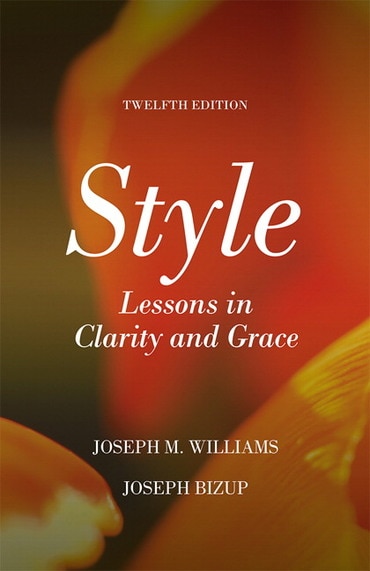
This is not an easy book to find. It was not one I knew of by reputation, even though I’m a bookseller and a nerd about the craft of writing. It was lauded in a book I read last summer, The Elements of Academic Style: Writing for the Humanities by Eric Hayot. From that book’s opening to Chapter Two:
Why write a book on scholarly writing for graduate students and faculty in the humanities? Partly because no such book exists.
Other volumes, most famously Strunk and White’s Elements of Style, cover aspects of writing essayistic nonfiction style at the sentence level. Even fewer cover structure; Joseph M. Williams Style stands out in that arena.
Great, I thought, I’ll track down a copy. A recent edition wasn’t available used at Half Price Books or Thrift Books. I looked up how much it cost new; it was a prohibitively high $85 and up, with some very sketchy-to-me options for renting and electronic forms; no thank you. I found an older copy listed at my local public library and put myself on the waitlist. It was eventually marked missin. I presumed it was stolen by someone who found it very useful and didn’t want to pay retail for it. Then, I began a graduate program and got access to an academic library. I walked in, found the 12th edition on the shelf, and didn’t have to return it for four months. It is useful. So much so that I’m vexed I’m not able to get a reasonably priced physical copy of my own. A used copy of the newest edition starts at $125? I don’t think so. This is why I’m writing this review: to quote it. And, for other writing and usage nerds like me, in case you might have an easier time than I did finding a copy.
Brief aside: at my last bookselling job, we were tasked with keeping an eye out for counterfeit books. Did you know counterfeit textbooks were a thing? I didn’t either, but once I saw current textbook prices I understood why.
I read Style over several weeks, just a few pages a day each morning. It was smart without being pedantic, and thorough. He has a section on real grammatical rules versus folklore that I found eye opening, but I think it might bring some usage nerds to blows over his distinction among real rules, social rules and invented rules.
Inside front cover includes this list of ten principles to write clearly
- Distinguish real grammatical rules from folklore
- Use subjects to name the characters in your story
- Use verbs to name their important actions
- Open your sentences with familiar units of information
- Get to the main verb quickly
- Push new, complex units of information to the end of the sentence
- Begin sentences that form a unit with consistent subjects/topics
- Be concise
- Control sprawl
- Above all, write to others as you would have them write to you.
Inside back cover includes this list to write coherently:
- In your introduction, motivate readers to read carefully by stating a problem they should care about.
- State you point, the solution to the problem, at or near the end of that introduction
- In that point, introduce the important concepts that you will develop in what follows
- Make everything that follows relevant to your point
- Make it clear where each part/section begins and ends
- Order parts in a way that makes clear and visible sense to your readers
- Open each part/section with its own short introductory segment
- Put the point of each part/sectionat the end of that opening segment
- Begin sentences that form a unit with consistent subjects/topics
- Create coherent old-new ties between sentences
Here were some other things I found helpful:
“If writers whom we judge to be competent regularly violate some alleged rule and most careful readers never notice, then the rule has no force. In those cases it is not writers who should change their usage, but grammarians who should change their rules” (16).
Revision is a three step process: analyze, assess, rewrite (35).
When you start to draft a new section of your paper, list the topics and characters you intend to write about. Include not just flesh-and-blood characters, but important concepts as well. As you draft, try to put those characters into the subjects of most of your sentences. If you do not mention one of those characters for several sentences, you may have gotten off track.
Likewise, when you must read a passage you expect to be difficult, first skim it quickly to find its main topics and characters. Think about them for a moment. The more sharply you have them in mind, the more easily you will understand the passage (73).
In general, your sentences should begin with elements that are relatively short…The general principle is to carry the reader not from complexity to simplicity but from simplicity to complexity (82)
Writers often order their documents chronogocially because that is easiest for them…Order your ideas not in the way that is easiest for you, but in the way that best helps your readers understand them (114).
“A long complicated sentence should force itself upon you, make you konw yourself knowing it–Gertrude Stein” (137) Stein is one of the only/few women used as examples in the book.
Topic then stress: Begin sentences with what they are “about” or “comment on”; end with words that should receive special emphasis (171).

